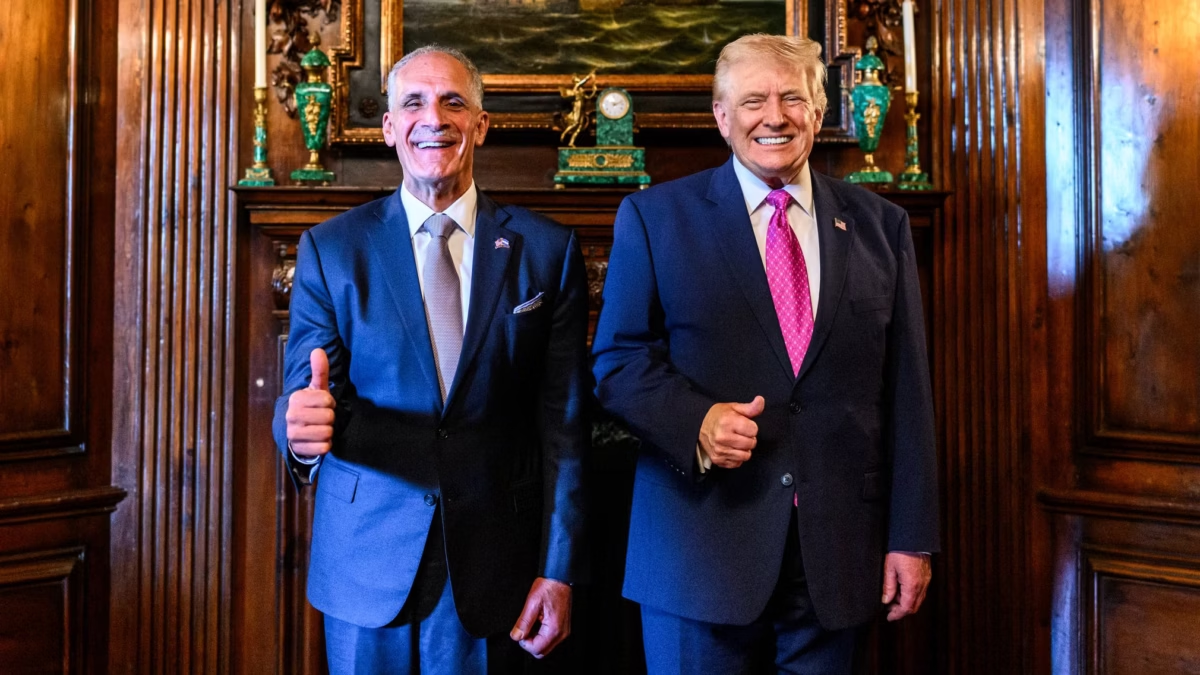
Tegucigalpa, Honduras – Prior to meetings with high-ranking U.S. officials, President Nasry Asfura of Honduras was received on February 7, 2026, by President Donald J. Trump at his private residence in Mar-a-Lago, Palm Beach, Florida, USA.
President Trump, who declared Nasry Asfura a friend in a post on his Twitter account, received the Honduran leader in a private meeting to discuss security, migration, the economy, and diplomatic cooperation.
President Trump also expressed his support for President-elect Nasry Asfura in the lead-up to the general elections in Honduras on November 30, 2026.
Economy and Investment
Interoceanic Railway: President Nasry Asfura highlighted that during the meeting, they discussed with the US president a proposal for the construction of the interoceanic railway, a project pursued by several Honduran governments. Studies have already been conducted, but the necessary funding for its execution is lacking. “I showed him a map of Honduras with the possible railway route; he kept the map and agreed to review and study it,” he noted.
Regarding economic investment, strategic sectors such as artificial intelligence, technology, and manufacturing were identified as areas that could attract foreign capital if the country’s competitiveness is improved. “We discussed investment in artificial intelligence, technology, and higher-level manufacturing,” he explained.
Honduras also requested a review of tariffs to regain competitiveness against other countries in the region and promote job creation. “I brought up the issue of the 10% and 25% tariffs, because we are at a disadvantage compared to Guatemala and El Salvador,” he pointed out.
Security, Migration and Health
Security: The mutual commitment to combating drug trafficking and organized crime was reaffirmed. “We will strengthen all efforts against organized crime and review our laws to further strengthen our relations,” he explained.
Migration: The continuation of Temporary Protected Status (TPS) and the strengthening of legal cooperation mechanisms were discussed, with an agreement to conduct a review without immediate conclusions. “We agreed to review all the laws and the work we must do for Honduras,” he stated.
Health: The Honduran government presented progress in reducing the surgical backlog and reactivating the national distribution of medications. “We have approximately 16,000 surgeries on the backlog, and we are working to address them. We have also begun the nationwide distribution of medications,” he indicated.
Foreign Policy
President Nasry Asfura confirmed progress in the process of appointing ambassadors to both countries, as well as the formation of bilateral working groups that could begin next week. “We already have the working groups ready and a great team prepared to start negotiations,” he stated.
At the regional level, the discussion focused on the stability of the Northern Triangle (Guatemala, El Salvador, and Honduras), emphasizing the role of the private sector as an engine of development.
The meeting, which lasted more than 45 minutes, was described as a fluid and positive conversation, highlighting the historical relationship between Honduras and the United States, which dates back almost two centuries. “It was a very pleasant conversation, and I am very pleased with how the United States views Honduras today,” he expressed.
The meeting at Mar-a-Lago marks an accelerated and unusual start to the bilateral relationship, not only because of the speed with which it took place, but also because of the breadth of topics addressed. Beyond political gestures, the emphasis on investment, tariffs, and competitiveness suggests that the Honduran government is seeking concrete economic results in the short term.
The true impact of this meeting will now depend on how quickly the technical working groups are activated and whether the commitments made translate into agreements that improve Honduras’s standing with its neighbors and strengthen its relationship with its main trading partner.